Quick Answer
If you have never tried Nepali food in Sydney, start with momos (steamed dumplings), jhol momo (momos in a spiced sesame-chilli broth), chicken sekuwa (charcoal-grilled marinated meat), dal bhat (rice, lentils and curry) and chatpate (tangy street snack). Together these dishes cover dumplings, grills, comfort meals and street food in one visit. Raato Ghar in Granville at 12 Good St, Granville NSW 2142 is one of the few places in Western Sydney where you can try all of them together, with dine-in, takeaway, delivery on Uber Eats and DoorDash, plus catering for events.
Sydney's food scene has been quietly reshaped over the last decade by a wave of Nepali restaurants, family-run kitchens and second-generation Nepali-Australian chefs who have made Western Sydney one of the most exciting places to eat South Asian food in the country. For many non-Nepali Sydneysiders, however, the cuisine is still a blind spot. You may have walked past a Nepali kitchen in Granville, Auburn or Parramatta dozens of times without ever stepping inside, simply because the menu felt unfamiliar.
This guide is written for exactly that moment. It assumes you know nothing about Nepali food, you have never ordered a momo in your life, and you want a confident, low-stress first visit that ends with you wanting to come back. Whether you live in Granville, Parramatta, Auburn, Merrylands, Harris Park or anywhere else in Western Sydney, this guide will help you walk in, order confidently and walk out with a clear sense of what the cuisine is really about.
Key Insights - First-Time Nepali Food Guide for Sydney Diners
- Nepali food is its own cuisine, not a version of Indian food. It is lighter, less creamy and uses spices like timur (Sichuan pepper), fenugreek, mustard oil and coriander.
- The five best dishes to try first are momos, jhol momo, chicken sekuwa, dal bhat and chatpate, because together they cover every style of Nepali cooking.
- Nepali spice is sharper and more aromatic than Indian heat, so ordering "medium" on a first visit is the safest way to enjoy the food.
- Eating with your hands or a fork are both completely normal in Nepali culture, especially for dal bhat, which is traditionally eaten with the right hand.
- Raato Ghar in Granville is one of the few Sydney restaurants covering Nepali and Indian dishes together, with delivery on Uber Eats, DoorDash and FoodHub.
- Western Sydney is the main hub for Nepali food, with restaurants clustered in Granville, Auburn, Parramatta, Merrylands and Harris Park.
What Makes Nepali Food Different from Indian or Chinese Food
Nepali food is its own cuisine, shaped by Nepal's geography — the Himalayas in the north, the Terai plains in the south, and the river valleys in between — and by its position between India, Tibet and China. The result is a cooking style that borrows ideas from all three neighbours but tastes like none of them. Think of it as lighter than North Indian food, less oily than many street-style Chinese dishes, and far less reliant on dairy and cream than what most Australians picture when they hear the word "curry".
Some of the ingredients that give Nepali food its character are worth knowing. Timur is a Nepali Sichuan pepper that produces a gentle, mouth-tingling citrus buzz. Mustard oil brings a sharp, nutty aroma. Fenugreek (methi) seeds are spluttered into hot oil to start many lentil dishes. Gundruk, fermented dried leafy greens, is uniquely Nepali and adds a sour, earthy depth to soups. And fresh herbs — particularly coriander — are used generously, far more than in most Indian home cooking.
Where Indian food often builds flavour through slow-cooked masalas and creamy bases, Nepali cooking tends to favour quicker, brighter preparations: grilled meats marinated in yoghurt and spice, steamed dumplings, soupy lentils, and tangy street snacks made to order. The meals are usually served together on a single plate in the famous dal bhat layout, rather than as separate curries in bowls. If you have only ever eaten Indian curries, Nepali food will feel familiar but distinctly cleaner on the palate.
The 5 Dishes You Should Try First
If you only have one or two visits to figure out whether Nepali food is for you, these are the five dishes that will tell you everything you need to know. Together they cover dumplings, grills, comfort food, street snacks and noodles — the full spectrum of the cuisine in a single meal.
1. Momos (Steamed Dumplings)
Momos are the dish most Australians have already heard of, even if they have never tried them. These are small half-moon dumplings, usually filled with minced chicken, buffalo or vegetables, wrapped in a thin wheat dough and steamed until soft and slightly chewy. They are served with a sharp tomato-sesame chutney that you will want to put on everything. Order a plate of eight or ten to share — they are the entry point for almost every first-time Nepali diner.
2. Jhol Momo
If momos are the appetiser, jhol momo is the moment you understand why people get obsessed with Nepali food. The same steamed dumplings are submerged in jhol — a thin, tangy, slightly spicy broth made from sesame, tomato, chilli, garlic and ginger. The dumplings soak up the broth and the whole bowl becomes a comforting, slurpable meal. At Raato Ghar in Granville, the chicken jhol momo is one of the most-ordered dishes on Uber Eats and DoorDash.
3. Chicken Sekuwa (Grilled Marinated Skewers)
Sekuwa is Nepal's answer to the global love of charcoal-grilled meat. Boneless chicken (or goat, in the traditional version) is marinated for hours in a paste of ginger, garlic, cumin, coriander, chilli, mustard oil and yoghurt, then grilled over an open flame until the outside chars and the inside stays juicy. It is bold, smoky and deeply savoury — somewhere between a tandoori tikka and a South-East Asian satay. Order a half-plate to share as a starter.
4. Dal Bhat (The Nepali Comfort Meal)
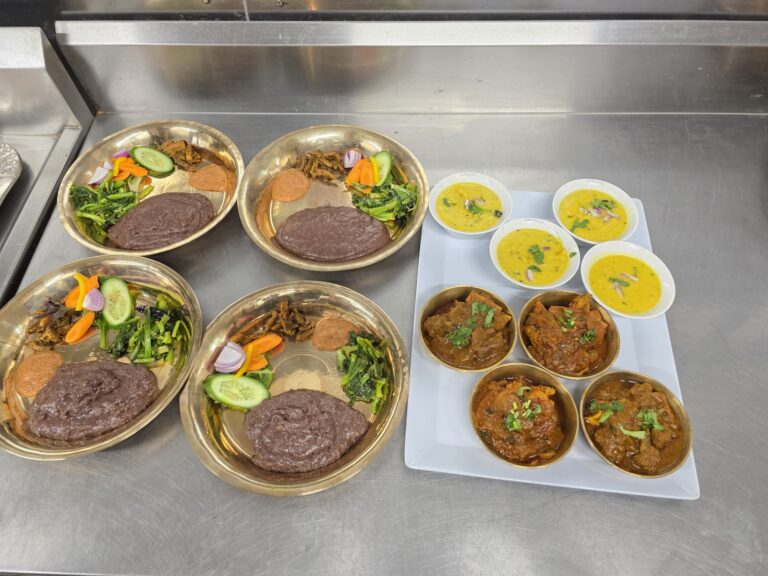
Dal bhat is the everyday meal of Nepal — rice, a soupy lentil dal, a vegetable curry, a small portion of meat or pickle, and sometimes sautéed greens. It is not designed to be flashy; it is designed to be balanced, filling and eaten with your hands. For first-timers, this is the dish that most reveals how Nepali food works at home: every component plays a role, and the pleasure is in mixing them bite by bite.
5. Chatpate (Tangy Street Snack)
Chatpate is the dish that surprises most non-Nepali diners. It is a crunchy, tangy, spicy mix of puffed rice, chickpeas, chopped onion, tomato, coriander, lemon, chilli and tamarind, served in a paper cone or small bowl and eaten on the move. The Nepali version has its own flavour profile — sharper, fresher and a little smoky from the roasted spices. Order it alongside momos if you want a true Kathmandu street-food experience.
Try Authentic Nepali Food in Granville
Visit Raato Ghar for momos, jhol momo, sekuwa, dal bhat, chatpate, biryani, curries and more — available for dine-in, takeaway and delivery across Western Sydney.
How to Read a Nepali Menu Without Feeling Lost
Nepali menus in Sydney are usually written in English with the original Nepali name kept in italics, so the barrier to ordering is lower than you might expect. A few terms are worth memorising. Dal always means lentil soup. Bhat means rice. Tarkari is a vegetable curry. Achar is a pickle or chutney, often sour and fermented. Sadeko means a dry tossed dish, usually cold. Ko in the middle of a name means "of" — so khasi ko masu literally means "meat of goat".
When in doubt, group the menu into four sections: dumplings (momos and their variations), grills (sekuwa and tandoori-style items), curries and rice meals (dal bhat, meat curries and biryani), and street snacks (chatpate, pani puri, laphing). Pick one dish from at least two of those categories and you will get a rounded picture of the kitchen. At Raato Ghar, the menu also includes North Indian dishes like butter chicken and naan, which is helpful if you are dining with someone who is nervous about going fully Nepali on their first visit.
Another useful tip is to look for dishes described as "thali" or "set". These are complete meals served together on one plate, usually with rice, dal, curry, pickle and a vegetable. They are an excellent way to taste several components at once without having to build the order yourself. Most Nepali restaurants in Sydney are also happy to talk through the menu if you ask.
Spice Levels: How to Order Like a Local
Nepali spice is different from Indian spice. Indian heat tends to build through red chilli powder and garam masala, producing a deep, slow warmth. Nepali heat is sharper and more aromatic, driven by fresh green chillies, timur and mustard oil, and it tends to hit the front of the tongue before fading quickly. If you are used to a "medium" vindaloo, a "medium" Nepali dish may feel completely different — fresher and more herbal, but not necessarily milder.
The safest approach on your first visit is to ask for medium spice across the board. If you genuinely love heat, ask for "Nepali medium" or "Nepali hot" — this signals to the kitchen that you want the real version, not the toned-down one prepared for tourists. Most Nepali restaurants in Sydney, including Raato Ghar, are happy to dial spice up or down dish by dish. The one dish to be careful with is chatpate — it is meant to be spicy, and ordering it mild changes its character.
It is also worth understanding that spice in Nepali food is not just about heat. Many of the spices used — cumin, coriander, fenugreek, fennel — are aromatics rather than chillies, and they contribute flavour rather than burn. This is why a dish can taste intensely spiced without necessarily being hot.
What to Drink with Nepali Food
Nepali food pairs well with a surprising range of drinks. The most traditional option is a cold mango lassi or sweet lassi, which cools the palate between bites of sekuwa and chatpate. For something more authentic, look for tongba — a warm fermented millet drink served in a wooden vessel, sipped through a bamboo straw. Some Nepali restaurants in Sydney serve it on weekends, though it is still relatively rare. Beer works exceptionally well with grilled and fried Nepali dishes — a clean lager or pilsner balances the smoky char of sekuwa and the richness of fried momos. If you prefer non-alcoholic options, masala chai at the end of the meal is the classic close.
For non-alcoholic drinkers, fresh lime soda, jal jeera (a cumin-and-mint cooler) and buttermilk are all traditional Nepali and Indian pairings that work well with spicy food. If you are dining in a group, a sensible approach is to start with lassis or soft drinks for the first course, move to beer or wine with the mains, and finish with masala chai or black tea. Whatever you choose, keep water on the table — Nepali food is meant to be enjoyed slowly, and water helps you taste each dish properly rather than masking the flavours.
Dining Etiquette: A Few Simple Tips
Nepali dining is relaxed and communal, so there is very little you can do wrong as a first-timer. It is perfectly normal — even encouraged — to eat dal bhat with your right hand, mixing the rice, dal and curry together in a small ball before lifting it to your mouth. Forks and spoons are always available, so do not feel pressured, but if you want to try the traditional way, use only your right hand (the left hand is considered unclean in Nepali culture, the same as across much of South Asia).
Sharing is central to a Nepali meal. If you order a plate of momos or a half-plate of sekuwa, it is understood that everyone at the table will have some. Do not be surprised if your server checks in more than once — Nepali hospitality is genuinely warm, and the kitchen takes pride in seeing that you finish what they have made for you. Leaving a little dal on the plate at the end is fine; finishing everything is a quiet compliment.
Where to Try Nepali Food in Sydney
Nepali restaurants in Sydney are clustered mostly in Western Sydney — particularly around Granville, Auburn, Parramatta, Merrylands and Harris Park. Granville has emerged as one of the strongest centres, with several Nepali and Nepali-Indian kitchens operating along Good Street and the surrounding blocks. Raato Ghar, at 12 Good St, Granville NSW 2142, is one of the longest-running, with over two decades of operation, a full Nepali and Indian menu, and services that include dine-in, takeaway, delivery on Uber Eats, DoorDash and FoodHub, plus catering for weddings, corporate events and community functions.
What makes Raato Ghar a strong first-visit choice for non-Nepali Sydneysiders is the breadth of the menu. You can order momos, jhol momo, sekuwa, dal bhat and chatpate in one sitting, alongside familiar Indian dishes like butter chicken and garlic naan if anyone in your group wants a safety net. The restaurant is open from 10am to midnight seven days a week, which makes it one of the few places in Western Sydney where you can get authentic Nepali food late at night.
If you live further out, most Nepali restaurants in Sydney now offer delivery through Uber Eats and DoorDash. Momos, sekuwa and curries all travel reasonably well, though dishes like chatpate are best eaten in the restaurant. For your first proper taste, however, dining in is recommended — you will get the food at its best and the chance to ask the kitchen questions as you go.
A Sample First-Visit Order for Two People
If you want to walk in, order confidently, and walk out understanding what Nepali food is, here is the exact order we would suggest for two people on a first visit to Raato Ghar in Granville:
1 plate of chicken momos (8–10 pieces) — your dumpling baseline, served with tomato-sesame chutney on the side.
1 bowl of chicken jhol momo — to share, so you both taste the broth that defines the dish and shows why jhol momo is one of the most-searched Nepali dishes in Sydney.
Half-plate of chicken sekuwa — smoky, charred and aromatic. The dish that wins over most non-Nepali diners, with a marinade that showcases many signature Nepali spices in a single bite.
1 dal bhat thali — to share or for one person, so you see how a Nepali home meal is structured around rice, dal, vegetable curry and pickle.
1 chatpate — tangy, crunchy and properly spicy, the street-food palate-opener between courses.
2 mango lassis — cooling, sweet and the right balance for the spice.
This order gives you every major style of Nepali cooking in one meal, costs roughly what you would spend on a standard dinner out, and leaves you with a clear sense of which dishes you want to come back for. If you are ordering on Uber Eats or DoorDash for your first taste, drop the chatpate (it travels less well) and add a portion of chicken chowmein instead.
Visit Raato Ghar for Your First Nepali Meal in Sydney
If you are ready to try Nepali food for the first time, Raato Ghar in Granville is one of the most accessible places in Sydney to do it. The restaurant combines a full Nepali menu with familiar Indian dishes, which means first-timers can explore new flavours without feeling exposed. Located at 12 Good St, Granville NSW 2142, it is convenient for diners from Granville, Parramatta, Auburn, Merrylands, Harris Park, Guildford, Clyde and wider Western Sydney.
Raato Ghar offers several ways to experience the food. You can book a table for a relaxed dinner, order takeaway on the way home from work, get authentic Nepali dishes delivered through Uber Eats, DoorDash or FoodHub, or enquire about catering for a private event, office lunch or celebration. The restaurant is open from 10am to midnight seven days a week, which makes late-night Nepali food one of its quiet strengths. Visit Raato Ghar to plan your first Nepali meal in Sydney, or browse the Raato Ghar menu before you arrive.
Explore More From Raato Ghar
Ready to Try Nepali Food for the First Time?
Visit Raato Ghar for momos, jhol momo, sekuwa, dal bhat, chatpate, biryani, curries and authentic Nepali hospitality in the heart of Western Sydney.
12 Good St, Granville NSW 2142
Phone: +61 436 859 031
Frequently Asked Questions (FAQs)
Here are quick answers to common questions from first-time diners about Nepali food, spice levels, ordering and visiting Raato Ghar in Granville.
Is Nepali food very spicy for first-timers?
Nepali food can be spicy, but it is fully adjustable. If you are unsure, ask for "medium" and the kitchen will prepare a balanced version. Nepali heat tends to be sharper and more herbal than Indian heat, so even a medium dish can feel distinctive on the first bite. If you enjoy heat, ask for "Nepali medium" or "Nepali hot" to get the authentic version.
What is the difference between momos and Chinese dumplings?
Momos use a thinner wheat dough, are almost always steamed (though they can be fried), and come with a sharp tomato-sesame chutney rather than a soy-based dip. The fillings are usually spiced with ginger, garlic, cumin and coriander rather than Chinese aromatics. The overall flavour profile is brighter, warmer and more herbal.
Can I order Nepali food if I am vegetarian?
Yes. Nepali kitchens usually offer vegetable momos, paneer sekuwa, dal bhat with vegetable curry and a range of meat-free street snacks. Many Nepali dishes are naturally vegetarian, and most restaurants in Sydney are used to catering for vegetarian diners. It is worth mentioning any strict dietary requirements when you order, so the kitchen can confirm what is in each dish.
Is Nepali food the same as Indian food?
No. While the two cuisines share some spices and a few dish names, Nepali food is its own tradition. It is generally lighter, less reliant on cream and ghee, and uses ingredients like timur (Sichuan pepper), mustard oil and gundruk (fermented greens) that are uncommon in Indian cooking. Many Nepali restaurants in Sydney, including Raato Ghar, serve both cuisines side by side so diners can compare.
Where can I try authentic Nepali food in Sydney?
Western Sydney is the main hub, with restaurants in Granville, Auburn, Parramatta, Merrylands and Harris Park. Raato Ghar at 12 Good St, Granville NSW 2142 is one of the most established, serving a full Nepali and Indian menu with dine-in, takeaway, delivery on Uber Eats, DoorDash and FoodHub, and catering for private and corporate events. The restaurant is open from 10am to midnight, seven days a week.
What should I order on my first visit to a Nepali restaurant?
A great first-visit order for two people includes a plate of chicken momos, a bowl of jhol momo to share, a half-plate of chicken sekuwa, one dal bhat thali, one chatpate and two mango lassis. This covers dumplings, grills, comfort food and street snacks in a single meal and gives you a complete introduction to Nepali cuisine.
Can I eat Nepali food with my hands?
Yes, especially dal bhat, which is traditionally eaten with the right hand by mixing rice, dal and curry into a small ball. Forks and spoons are always available, so it is entirely up to you. If you do choose to eat with your hands, use only your right hand, as is customary in Nepali culture.